
[Preface: Admittedly, a different man wrote this so many moons ago. I was prompted to resurrect it because I heard through the digital grapevine that one of my grammar school classmates died recently. Morgan McKnight. I don’t know what happened. I just know that as a mental health professional I used to think the worst thing you could tell grieving family members was “HE IS IN A BETTER PLACE.” Yeah. It’s 2018 now. Take a look. I’m thinking Morgan is in a way better place than this neolithic freak assbackwards horrorshow we are now witnessing. A lot of what’s in here is relevant for the hypocritical shit show that tortures me on a daily basis. I wrote this for all of them and sent it out via email blast once upon a time. Then I tried to immortalize it several years after that in a Fakebook “NOTE.” I think i “tagged” some of them. But you know–social media. Got buried in all the busy-ness of bullshit and moneygrubbing everything eventually devolves into. So, now that I’m social media- free, I figured The Blog was best way to take voluntary hostages to my musings. It’s also a preface to something else forthcoming about how Barraza wound up so intrigued by Man’s Inhumanity. For now, though, this. Circa 2006.]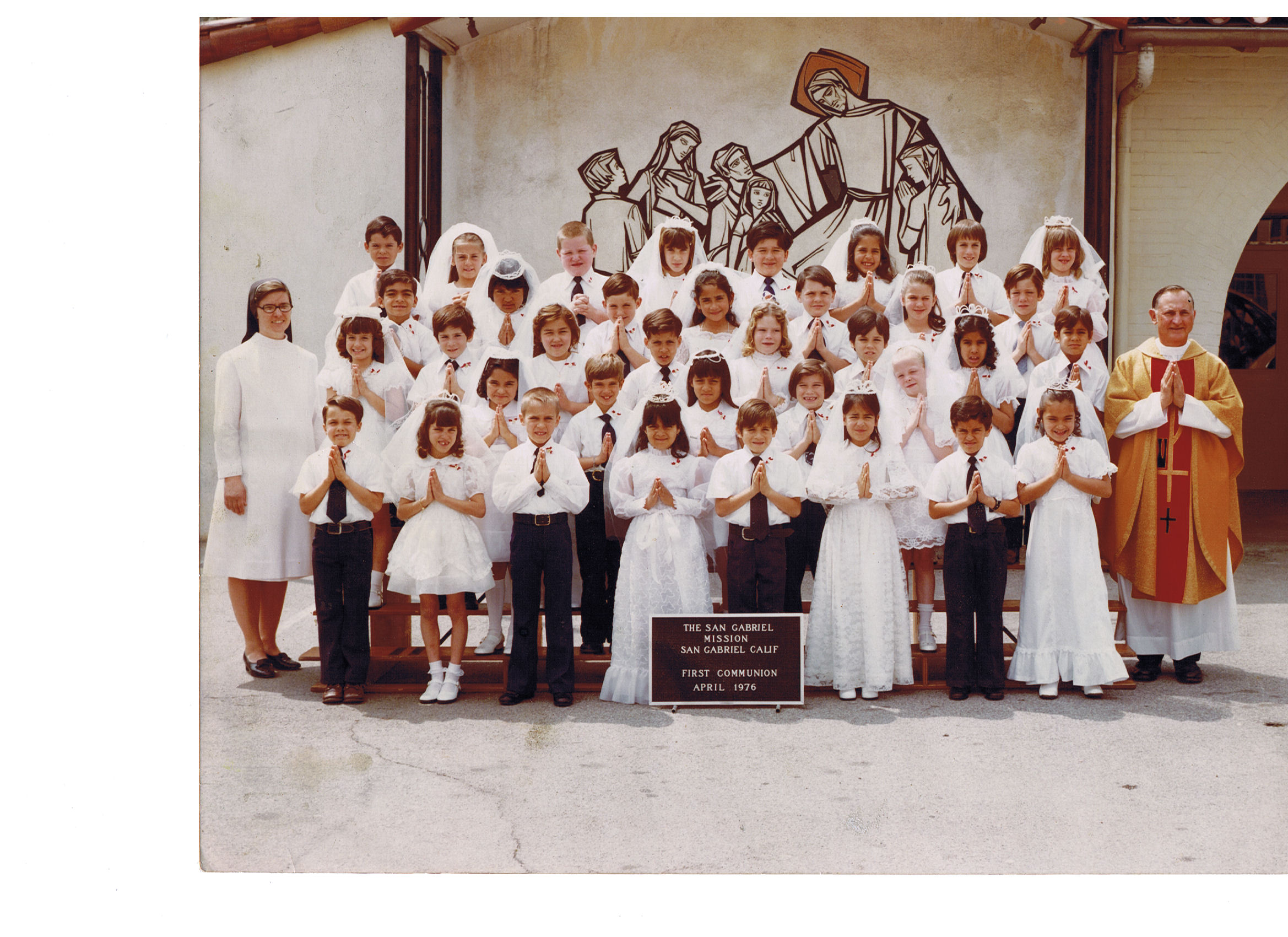
Dear former Mission Grammar Classmates,
These are just some words, thoughts, impressions, and meanderings I had about the reunion and wanted to share. Sorry so late. Life is what happens when you’re busy making plans. I was inspired first and foremost to “pen” something by the experience; and secondly by the reaction I got from so many people when I told them about the reunion. Time and again I heard the resounding and incredulous, “Grammar school?” “YES,” I’d proudly reply,
“GRAMMAR SCHOOL!”
Then I’d try explaining it to them…as I will now do to you.
Disclaimer/Caveat/Warning: I’m not short on words. Never have been. It’s what Mrs Lockwood encouraged, what baffled and terrified Sisters Marcelina and Darlene; what remained foreign concept to Sweeters and Abramjian.
Me, words, writing (but not necessarily spelling so many years later)…they’ve been air and water—and whisky and wine to me for as long as I can remember.
Or so I’ve been told.
This could be long, we could go places here, but I promise it will be fun and adventurous and none of it will hurt (too much). Feelings aren’t always supposed to be good, but they are, trust me on that one.
If nothing else, I hope you “get” it.
During my last year of college—the year was 1992; you remember, The Nineties, don’t you?—I had to take a senior elective course. I was a Behavioral Science Major and (don’t laugh) Criminal Justice Minor. An upper division Big Brain elective course was required. Stuff like Research Methods 410 or Teach Rats How To Run a Maze/Advanced Psychology Experimental Design. (And yes I did teach two white mice to navigate a maze that year for the Psychology Club’s display.) So, being the challenge -hungry Spartan Survivor that I was, I enrolled in Dr. William R. Larson’s “SPECIAL PROBLEMS FOR UPPER DIVISION.”
Sophisticated stuff…indeed.
Here’s what the syllabus looked like:
SUPPLIES:
Crayons
markers
glue
scissors
colored paper
Show and Tell Item
Pictures.
A diary/journal.
comfortable clothes.
BOOK:
All I Really Need To Know I Learned in Kindergarten, R. Fulghum.
Maybe there was another book, but I don’t know. What was most impressive was what we did in that class.
We played hide and go seek on the quad. And dodge ball. And Duck-Duck-Goose! We had Show and Tell. We drew pictures of ourselves, our families, our experiences, our dreams, our hopes and our fears—and then we stood in front of the class and shared about them. That was the thing of it; we shared. In that classroom, grown men cried about lost love and death; women reverted to little girl-hood in one fell swoop from a teddy bear from that phase of their development; there was uncovering and discovering—of the painful, shameful, horrendous, beautiful, scary, tender, loving and overwhelming thing that is life. Some brought out things they’d been trying to hide. It became slowly apparent during the quarter that the indirect, yet inherently intended lesson of the class was simple: The one thing we are usually most afraid of is the one thing we can never really escape, try as we may: Ourselves.
There was the old adage: “You can run, but you can’t hide.”
Finally, it made sense.
What happened in that class more therapeutic and instructive than any group, class, seminar, therapy session or in-service I’d ever taught, ran, participated in or attended.
Eventually, the Dean and the necessary evil known as The Administration took notice of Dr. Larson’s class. They scrutinized his most unorthodox manners and techniques: The fact that it didn’t “…conform to the generally accepted standards of educational instruction..” and …blah blah blah, you get the picture. Here was the thing, though: They were powerless to do anything about it. That even became the topic of class one day. (The seats were never arranged in order, by the way; we arranged the desks in a circle and sat in a different desk every time. This was a tradition I kept well into my adult life, through graduate school. Did it ever strike anyone as odd that as children we had assigned seats and were for the most part told where to sit, and who to sit next to? Yet when we started going to school for school’s sake we found ourselves in the same seat week after week….and felt strange if someone else was in ‘our’ spot that day, felt intruded and encroached upon our comfort zone established by so many years of hard-wiring.)
So, Dr. William R. Larson was Ghandi—he would level you with simple words and tales. He was (Good) Will Hunting—rebellious, gruff and intriguing. He was John Keating—the fabled teacher of Dead Poets Society fame. He was a humble wise man teaching with the loudest most forceful way there is to teach: By example. By demonstration. By being. The end result of that class was that it would take several years, several different paths, more than a few King Sized Mistakes and learning the hard truth of “history denied repeats itself” before Dr. Larson’s wisdom sank in.
High school was a haze, the obligatory developmental phase of experimentation—of trial, error and imprisonment. Being both bookish and antisocial, I felt both terminally unique and permanently separate from my peers…which is the easiest diagnosis needing no credentials to detect: Adolescence. College was no different; the cliques were more clearly defined and the rebellion more structured. After the storm, came the calm and I began to transmogrify into the Least Recognizable MGS 1982 Attendee—the “me” you’ve all seen and heard way too much of already.
So, this is what I learned from Dr. Larson, so many years later (but more importantly, and in all fairness to him because he’d correct me on this point) I learned it from watching; from doing; from paying attention; from not just doing something but sitting there; from stopping; from letting go of everything I don’t need without order to get more of what I want within. And, most importantly from reverting to a wise, omniscient, sensitive, beautiful, simple, teachable, and almost perfect existence that I once yearned to be done with but now envy and yearn for: Childhood.
I want you to do something. Take a look at the picture of all of us from First Communion –or from the 4th, 6th and 8th grades. If you have your own picture, fine, if not log onto the website and do it, but by all means, do it, even if it’s a baby picture of yourself.
Go look at it now.
I’ll wait for you.
Did you look at it?
What did you see?
I can tell you, in too many words, of what I see, feel, and hear….
I see the most innocent loving beautiful children—God’s children all of them, perfect just the way they are (and still growing). I see how wise they are: When sad, they cry; when happy they laugh; when ashamed they cower; when angry they stamp their feet; when they don’t know something they raise their hands and ask questions. They were taught to share, to give to the needy, to pray when sirens and fire trucks and ambulances pass by. They were taught to pledge allegiance to all the good things their country stood for; to respect tradition but be open to those who looked, spoke and prayed differently than them. These were, after all, the children who cheered when the hostages were released in Iran, who stood in awe as the first Space Shuttle landed, who learned about the random universe when it became apparent that sometimes praying for the recipients of those ambulances and sirens didn’t always help.
Somewhere along the way, it is my firm and stubborn belief, kids get screwed up. Boys are taught not to cry, girls are implored to pamper and primp. Asking questions is discouraged (and sometimes punished) as a sign of weakness and dependence. Going against the status quo is often discouraged and taking a look inside is almost always marginalized and passed off with, “Well no one’s perfect.” But since when does that excuse any of us from taking a look at what needs examining anyway? Children are instructed, however erroneously, to believe the Fairy Tale will prevail: That being good pays off; that doing the right thing will be rewarded; that loving unconditionally leads one to avoid loss and abandonment.
How cruel the world seems when these children grow up to learn about a universe eternally indifferent and random: Where the good guys don’t always win, where “bad” things happen to “good” people, and where sometimes things just happen. Because sometimes we cry because nothing else helps—and we pray because crying doesn’t help. Some of us grew up in homes that baffled us, where the rules always changed. Rather than being the shelter from the storm, home was the storm itself. Some of us were lucky, and grew up unscathed and untouched by this. As Neil Young says, “Although my home has been broken/It’s the best home I ever had.” There was a little bit of all that where I grew up, but I’ll be damned that I didn’t realize until after my brother Mark died that we were a lot closer than I ever let on or wanted to admit.
That’s what resurfaces when reminiscing about that class: Mission Grammar School and the best years of my life—the best years of my emotional, simple, undistracted, “satisfied with what I had instead of getting everything I wanted” life. Here’s what I noticed at the reunion: All the men went to hug each other at first sight.
Smiles are universal across all cultures; from the jungles from Down Under all the way to the Bill Gates’ high tech crib, a smile means: Happiness. Some say that’s proof of God; we aren’t taught how to smile, but all human beings do it when they’re happy. Safe to say when you are moved to hug someone it’s an indication of connection. That’s they way I feel to that glorious, untouchable, eternal time at Mission Grammar School—when I was wiser and more content than I am now worrying about every problem I ever prayed for.
I could go on, really, for a long time, but I’ll leave you with this:
In September, during the Fiesta, Jennifer Hules and Ed Beal and I went to Mrs. Lowe’s and Mrs. Bell’s classroom. Surreal? You bet. Poignant? More than a little. Floodgates of memory lane unhinged. There’s that: The flag remains. As does the PA system speaker. The crucifix above the chalkboards remains. The desk is flush left. The cabinets we were never allowed into are still locked (and what were in those things anyway?) The obsolete roll up projector screen is gone, of course, but the brackets upon which it rested remain. And on the walls was the artwork of the smartest people in the world—the children. It was a portrait of Jesus, of course, adorned with construction tissue paper. There were symbols printed in Crayola surrounding Him. I took a picture of it with my so-un-childlike PALM TRE0 650—that 2 Gigabyte cell phone PDA web/text/email capable camcorder ball and chain that I can’t seem to live without. And prominent in children’s unmistakable script were these words:
DISCOVER.
and:
BELIEVE.
Thank ALL OF YOU for eliciting this; thank you to those of you that risked coming and being and seeing—sometimes the hardest part is showing up.
Thank you for walking into something that may have indeed been overwhelming, scary, and stressful. (I must’ve missed the day in school when they taught how to deal with stuff like that. My mom swears she was never given an instruction manual on how to teach me how to deal with love, loss, or being uncomfortable. I forgave her, but I’m still looking for that damned manual.)
Thank you David Komin for having this idea, for reaching out in your humble quiet way, for starting the momentum, for being Johnny Appleseed.
May all the best moments in your lives lie ahead of you.
May those of you blessed with children continue to see the world through their eyes and learn from them.
May those of you without who want that, be in a place to accept it and be ready for it when it comes.
May those of you who are right where you are and don’t know why be OK with that if just for now.
May everything be as it is with you now—and may God give you the grace to endure or accept that.
Discover. Believe
(!)
Matthew A. Barraza
 Difficult To Cure
Leave a comment